
Dupuytren’s Contracture
Is your finger stuck bent? It might not be trigger finger.
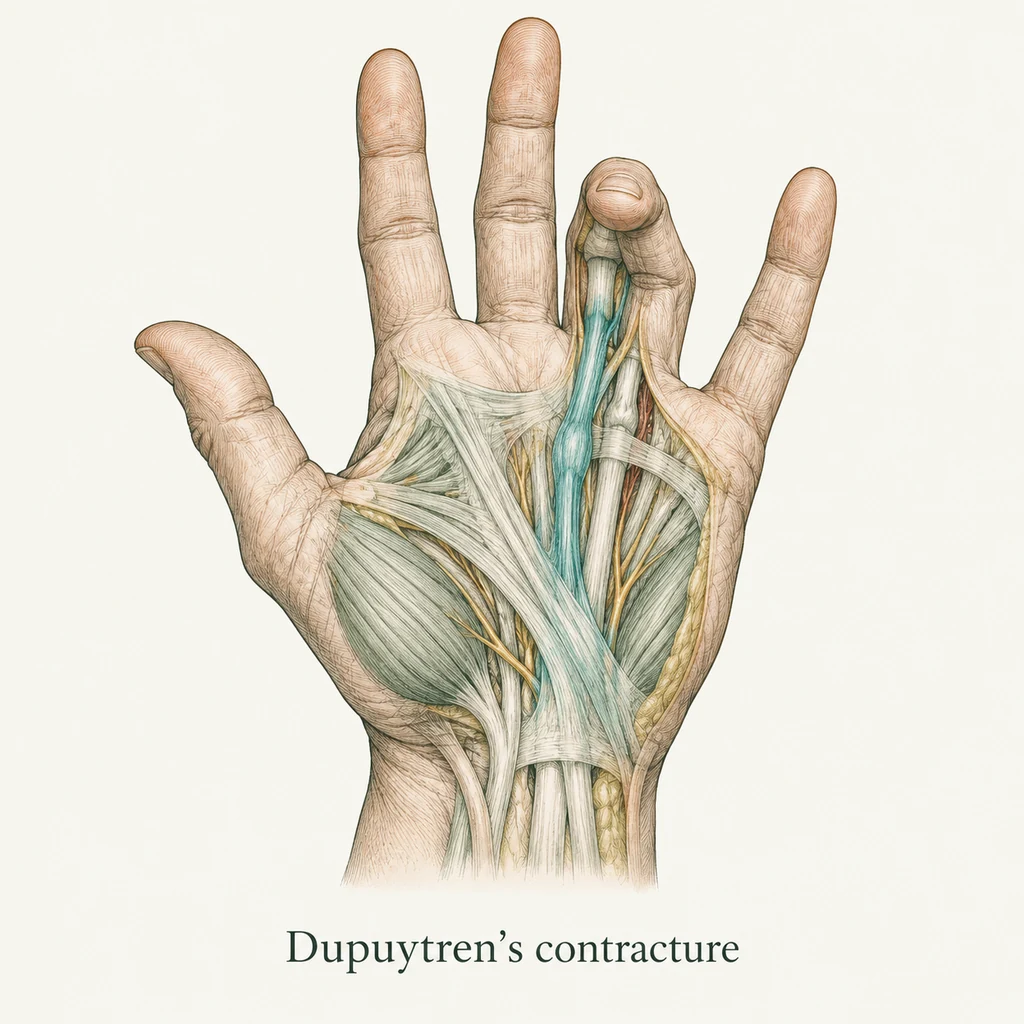
What is it?
Dupuytren’s disease causes nodules and cords in the palmar fascia; some cords progressively pull the ring or little finger toward the palm. Unlike trigger finger, the problem is not a flexor tendon catching at a pulley.
What causes it?
Genetic predisposition, increasing age, male sex, diabetes and certain lifestyle factors are associated with the disease. It is not simply caused by overworking the hands. Some nodules remain stable and never become contractures.
How do we distinguish it from other conditions?
The tabletop test—being unable to place the palm flat—can flag functionally important contracture, but is not diagnostic on its own. We assess function and refer for hand-surgery evaluation when contracture progresses.
How is it treated?
Physiotherapy and chiropractic care can support hand function, mobility and activity adaptation; they cannot reliably dissolve cords. RMT and osteopathic manual therapy may relieve secondary muscular discomfort or stiffness without aggressive work on nodules. Acupuncture may support associated pain but does not reverse contracture. Class 4 laser can be considered selectively for postoperative discomfort after surgical clearance; evidence specific to Dupuytren’s postoperative healing or inflammation is insufficient. Early studies of shockwave therapy for painful Dupuytren’s nodules are encouraging, but most use focused rather than Alliance’s radial shockwave equipment, so benefits cannot be assumed for radial treatment. Needle aponeurotomy or surgery may be indicated. Postoperative care may include scar management, mobility and grip strengthening; specialized hand therapy or splinting may be needed.
When should you seek treatment?
Seek assessment for new palmar nodules, progressive finger bending or difficulty placing your hand flat. Functional contracture deserves medical or hand-specialist review before it becomes severe.
Feel better. Together.