
De Quervain’s Tenosynovitis (Texting Thumb)
Has your thumb had enough of your screen time?
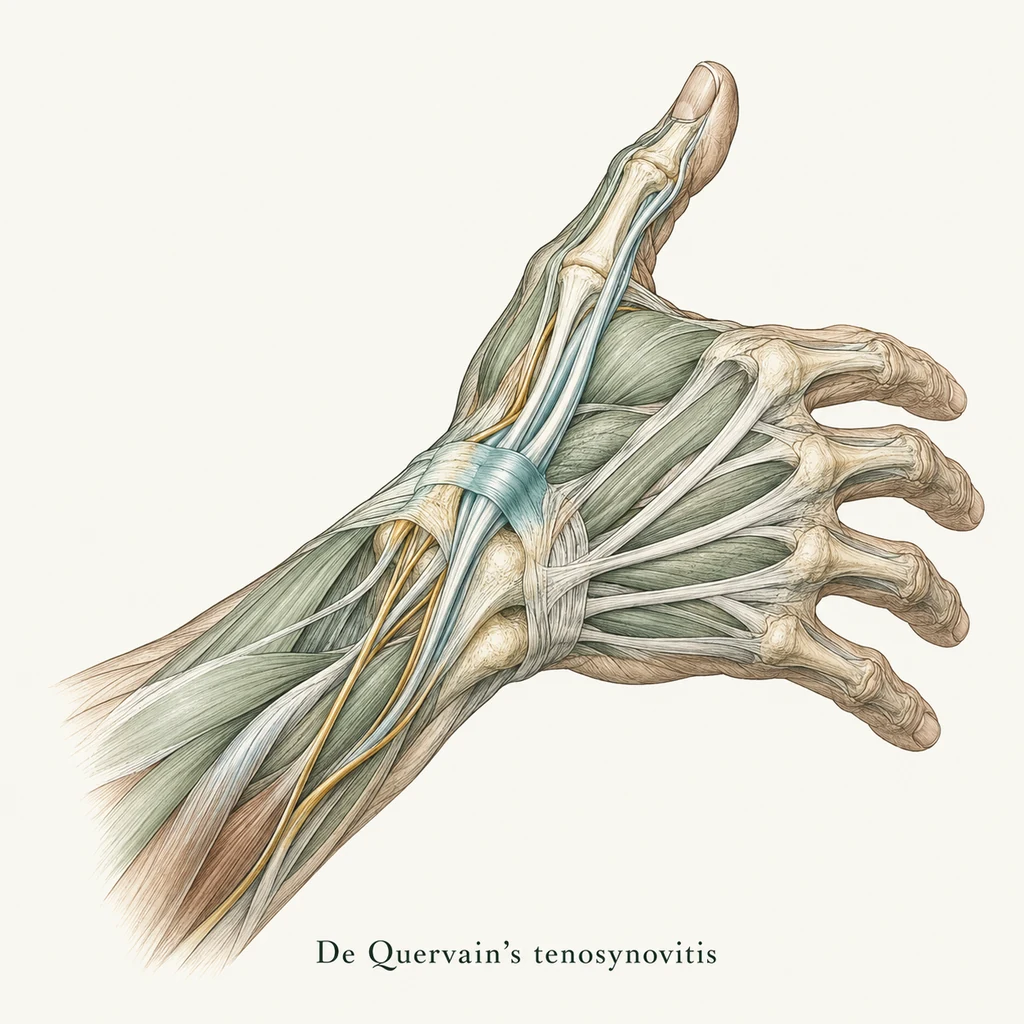
What is it?
De Quervain’s affects the thumb-side wrist tendon compartment containing abductor pollicis longus and extensor pollicis brevis. It often hurts with lifting, gripping, thumb movement or picking up a baby. “Texting thumb” is a nickname, not a specific diagnosis.
What causes it?
Pregnancy/postpartum changes, repetitive lifting, gripping and certain thumb/wrist movements can be associated with symptoms; many cases lack one clear cause.
How do we distinguish it from other conditions?
Thumb CMC arthritis, trigger thumb, superficial radial nerve irritation, intersection syndrome and other wrist disorders can mimic it. Thumb CMC arthritis is a differential diagnosis, not a separate page in this section.
How is it treated?
Physiotherapy and chiropractic care provide graded thumb/wrist loading, movement retraining, thumb spica splinting, taping and ergonomic coaching. Targeted IASTM may address associated forearm muscle restrictions without aggressive pressure over irritated tendons. RMT offers meaningful forearm and hand soft tissue care; osteopathic manual therapy assesses wrist, elbow and upper-extremity mobility; acupuncture can support pain relief and participation in rehabilitation, with developing condition-specific evidence. Class 4 laser may be considered selectively. Corticosteroid injection into the tendon sheath is an established medical option; persistent cases may require surgical release.
When should you seek treatment?
Seek care for persistent thumb-side wrist pain, difficulty lifting a baby or gripping. Significant swelling, fever, trauma or progressive neurological symptoms need medical assessment.
Feel better. Together.